
History of ice driving and the Andros Trophy
history of ice driving and what made this activity accessible to amateur drivers.
Before being a personal experience, ice driving was initially a specialist activity, born in the Scandinavian cold and then made real for more than thirty years by the Andros Trophy. This history, one of frozen lakes, full stadiums and an unexpected shift to EV, also explains why the activity has now opened up to non-professional drivers. Let’s take a look back at a trajectory that goes from the first ice races on the frozen lakes of the Far North to the Arjeplog circuits.
Table of contents

The origins of ice driving
Ice as an area of motorsport was not born in France. As early as the 1920s in Russia and Scandinavia, motorcycle racing on ice was already practiced as a leisure activity before becoming a structured individual competition in the 1930s. The same decade saw the appearance of car races on ice between professionals of cold climes. The first races took place mainly in Sweden.
Like NASCAR or the European Mountain Championship in their early days, these amateur races were largely ignored by the continental sports press of the time, so there were few precise historical landmarks to refer to.
Some sources place the democratisation of the activity to Finland in the 1950s, supported by races organised on frozen lakes to occupy the long Nordic winters.
It was not until the early 1990s that the culture of ice driving was introduced in France- but in what a way!

The Andros Trophy, the race that brought ice driving into French homes
1990, the birth in Serre Chevalier
The Andros Trophy was born from the meeting of two rugby and car enthusiasts: the driver Max Mamers and Frédéric Gervoson, boss of the Andros family group. On January 27th 1990, in Serre Chevalier, 70 competitors started in the first round of a championship that then had only four. At the time, no one imagined that this winter competition would become the most popular ice race in the world.
An activity that’s become a national show
Over the course of 35 events and more than 350 races, the Andros Trophy has become international on an unexpected scale. Even though it mainly takes place in the most beautiful French winter resorts, there are a few races in Andorra, and even as far away as Sherbrooke, Canada. Witness to the spectacular success of the activity, the Super-Final has been held eight times at the Stade de France, in front of a total of more than 400,000 spectators combined.
Well-known names braved the ice, from Alain Prost to Sébastien Loeb, as well as personalities from other sporting activities, proof that the Andros Trophy had gone far beyond the circle of motorsport enthusiasts. However, no driver will ever surpass Yvan Muller, an total expert in the activity with ten titles in eleven races.
The shift to electric
In 2019, for its 31st edition, the Andros Trophy becomes the Andros e-Trophy and switches entirely to electric propulsion: a rare shift on this scale in world motorsport, which requires existing drivers to thoroughly re-examine their driving style, without the usual gearbox or sound cues.
2024, the end of an event, a victim of the climate
On January 27th 2024, in Super Besse, the checkered flag was lowered for the last time. After 35 years in existence, the Andros Trophy bowed out. The activity that had democratised ice driving in France, after 35 years leaves behind a huge legacy, with more than 350 races and 2,000 drivers entered in at least one race.

The logical next step in ice driving: accessibility to amateur drivers
The Andros Trophy, as popular as it was, remained a competition: a tight field of licensed drivers, entered in teams, with a title at stake. A spectator could be enthusiastic about the performances of Yvan Muller and his opponents, but could not get behind the wheel.
We mentioned the fact that the culture of ice driving really appeared in France in the early ‘90s. Indirectly, Yvan Muller’s involvement in Lapland Ice Driving contributed to this movement. His fame and his driving skills give Lapland Ice Driving a real sounding board, as evidenced by this episode of Automoto filmed on our circuits with Franck Montagny, where Yvan Muller delivers a famous admission: you’ll do “more drifting in one day than in a driver’s entire life.” Even today, although he is no longer officially the face of the race, the ten-times champion of the Andros Trophy continues to return to Lapland Ice Driving events every winter and offers participants a spectacular baptism in a prepared Toyota Yaris.
In 2005, Lapland Ice Driving was officially born, and maintains the same philosophy to this day: to offer amateur drivers the opportunity of real ice driving, whatever their level. Several elements make this transition possible:
- Safe, licensed circuits, without any risk for you or for the sports vehicle fleet
- Reliable weather over several months, which guarantees access to the ice tracks throughout the season.
- A fleet of sports cars and supercars, from the Alpine A110 to the Ferrari 488 GTE.
- Individual supervision by professional instructors- who have raced in competition- available to accompany your progress.
It’s this accessibility that has made Lapland Ice Driving a reference: the possibility, for any enthusiast, to experience what a high-level driver like Yvan Muller has taken a career to master.
So it’s then quite natural that we have made him the ambassador of Lapland Ice Driving
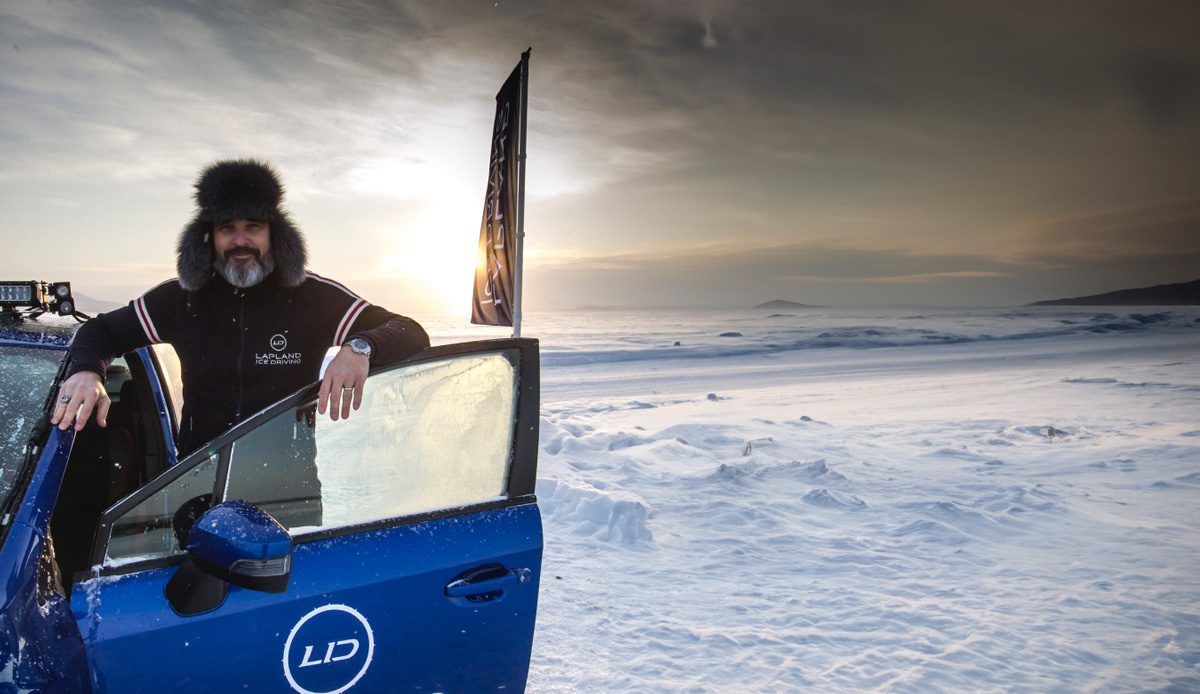
Write the rest of the story of ice driving
The Andros Trophy has written the popular story of ice driving in France. Its disappearance in 2024 closes a chapter, but not the activity itself. In Arjeplog, the same drifting continues, on ice that does not depend on the whims of a mid-mountain winter, alongside an ambassador who has himself experienced both sides of this history: competition and accessibility.
From now on, Lapland Ice Driving offers you the opportunity to experience ice driving at the heart of the largest driving centre in the world.